


What is Short Term Fixed Deposit?
A short-term fixed deposit is a bank or NBFC deposit with a maturity of seven days to 12 months that earns a fixed rate of interest, higher than a regular savings account. Rates vary by bank and tenure, and change periodically. It's a low-risk option for parking money you'll need again within a year, while it grows safely.

Given below are the interest rates offered on short-term deposits by top banks:
Bank | Regular FD Rate (p.a.) | Senior Citizen FD Rate (p.a.) |
SBI FD | 3.05% - 5.90% | 3.55% - 6.40% |
Axis Bank FD | 3.00% - 5.75% | 3.50% - 6.25% |
Kotak Mahindra Bank FD | 2.75% - 6.00% | 3.25% - 6.50% |
HDFC Bank FD | 2.75% - 5.75% | 3.25% - 6.25% |
Note: The tenure taken is less than 365 days and the deposit value is less than Rs.3 crore.
Note: Interest rates updated on 09 September 2026.
Benefits of Short Term Fixed Deposit
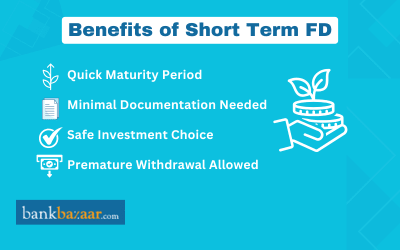
- The maturity term of a short-term fixed deposit ranges from seven days to less than 12 months.
- You can deposit money in such a term deposit only once.
- You can opt to renew the short-term fixed deposit account when it matures.
- The tax on the funds in the account is deducted as per the Income-tax Act, 2025.
- The rate of return on a time deposit account is usually high.
- Money can be withdrawn from an FD account before maturity but only after paying a fine. However, there are some banks which offer no penalty on withdrawing money before maturity.
- The minimum amount that you can invest in a short-term deposit account varies from bank to bank. It is generally around Rs.5,000. For minors, the starting amount is brought down by the banks.
Key Advantages of Short-Term FDs
- It is the ideal option if you want to have transitory savings.
- It provides greater liquidity with a high rate of return.
- A major advantage of such a fixed deposit is that it allows you to take a loan amount equivalent to 95% of the funds in your account without requiring a guarantor or any paperwork.
- There is a provision for nomination when you open a term deposit account.
- If you withdraw money before your term on the account ends, you will be charged an interest rate that is 1% less than the applicable rate.
- The government considers funds in the short-term fixed deposit account as security.
- The funds in short-term deposits can also be used as margin money for non-fund-based services.
- Deposits held with a bank, including a short-term fixed deposit, are covered by DICGC insurance up to Rs.5 lakh per depositor per bank (principal and interest combined), adding a layer of safety to your investment.
Requirements to Open a Short Term Fixed Deposit Account
To open this type of fixed deposit account, the requirements vary bank to bank. Most banks ask you to open a savings account along with the short-term fixed deposit account. This removes the hassle of collecting the interest amount in person and it can be directly transferred to your savings account.
Also, the account holder should be a resident Indian although some banks offer Non-Resident Indians (NRIs) the option to open a short-term fixed deposit account as well. To open a fixed deposit account, you would need identity proof, passport size photos and proof of address.
Some Options for Short-Term Investments
Investing and saving money is something everyone wants and needs. Even though, most of the time, saving money and investments are on a long-term basis. Mutual funds and fixed deposits are beneficial on a long-term basis and help with the accumulation of a large amount of money with the help of good interest rates.
However, it is also highly beneficial to invest money on a short-term basis. While long-term investments can range from one year to three years or five years or ten years, short-term investments range between one week to up to a year.
Bank Fixed Deposit
- A short-term bank fixed deposit is another method of investing money for a shorter period of time. The tenure for this type of fixed deposit can range between seven days and up to one year.
- The interest rate ranges between 2.75% per annum to 6.00% per annum which is taxable. There is no maximum limit for the fixed deposit, however the minimum amount can range from Rs.1000 to Rs.5000.
Post Office Time Deposit
- Under this type of short-term investment, the tenure ranges between one to five years. Only the 5-year Post Office Time Deposit qualifies for a tax deduction under Section 80C of the Income-tax Act.
- The rate of interest is high and ranges between 6.9% per annum to 7.5% per annum. The minimum amount required to open the account is Rs.1,000.
Flexi Fixed Deposit
- This is an alternative for a savings account where any kind of excess amount which is more than the stipulated limit can be shifted to a sweep-in fixed deposit account. This account is known by different names depending on the bank.
- The rate of interest is the same as the fixed deposits of the bank, which is around 6.5% per annum and the tenure is mostly 12 months. The interest earned annually will be taxed if it is above Rs.50,000 (Rs.1 lakh for senior citizens).
- There are other methods or options for short-term investments such as debt funds or debt mutual funds. The tenure is less than 12 months.
Summary
A short-term fixed deposit lets you lock in funds for anywhere from seven days to 12 months at a fixed interest rate, offering better returns than a savings account along with DICGC deposit insurance cover. Rates vary by bank and change periodically, so compare current rates before booking, and remember premature withdrawal usually attracts a lower rate or a small penalty. For money you'll need again within a year, a short-term fixed deposit offers a secure, low-effort way to earn steady returns.
FAQs on Short Term Fixed Deposit
1.What is a short-term fixed deposit?
A short-term fixed deposit is a deposit with a bank or NBFC that matures anywhere between seven days and 12 months while earning a fixed rate of interest. It offers a higher return than a regular savings account and is invested as a single lump sum. You can choose to renew the short-term fixed deposit once it matures.
2.How long can a short-term fixed deposit run for?
A short-term fixed deposit can run for anywhere from seven days up to a maximum of 12 months. Any deposit with a longer maturity is classified as a regular or long-term fixed deposit instead. The exact tenure slabs available for a short-term fixed deposit depend on the bank.
3.How is a short-term fixed deposit different from a regular fixed deposit?
A short-term fixed deposit matures within 12 months, while a regular fixed deposit can run for up to ten years. Both offer liquidity and a fixed rate of return, but a short-term fixed deposit suits money you expect to need again sooner. Regular fixed deposits generally offer more tenure choices across a wider time span.
4.Who can open a short-term fixed deposit account?
Any resident Indian can open a short-term fixed deposit account, and many banks also allow Non-Resident Indians to open one. Minors can usually open a short-term fixed deposit too, often with a lower minimum deposit set by the bank. Eligibility details can vary, so it's worth checking with your chosen bank.
5.What documents are needed to open a short-term fixed deposit account?
Opening a short-term fixed deposit account generally needs identity proof, address proof and a passport-size photograph. Many banks also ask you to hold or open a savings account alongside the short-term fixed deposit so that interest can be credited directly. Exact document requirements can vary slightly by bank.
6.Is a short-term fixed deposit a safe way to invest?
Yes, a short-term fixed deposit is considered a safe investment because it offers a fixed, guaranteed rate of return regardless of market conditions. Deposits held with a bank are also covered by deposit insurance up to a set limit per depositor per bank, adding an extra layer of protection. This makes a short-term fixed deposit a low-risk option compared with market-linked investments.
7.Can I withdraw a short-term fixed deposit before it matures?
Yes, most banks allow premature withdrawal of a short-term fixed deposit, though this usually comes with a lower interest rate or a small penalty. Some banks do offer short-term fixed deposits with no penalty on early withdrawal. It's best to check the premature withdrawal terms with your bank before investing.
8.Can I take a loan against a short-term fixed deposit?
Yes, a short-term fixed deposit can usually be used as collateral for a loan, letting you borrow a large portion of the deposit value without a guarantor or extra paperwork. This makes it a convenient way to access funds without breaking the deposit early. The loan terms and amount available vary by bank.
9.Is interest earned on a short-term fixed deposit taxable?
Yes, the interest earned on a short-term fixed deposit is taxable and is added to your total income for the year. Banks deduct tax at source once your interest income crosses a threshold set by the Income-tax Act. You can claim credit for this deduction when filing your income tax return.
10.Can I renew a short-term fixed deposit after it matures?
Yes, a short-term fixed deposit can usually be renewed once it reaches maturity, either for the same tenure or a different one. The renewal terms and interest rate applied depend on the bank's rates at the time. You can also choose to withdraw the funds instead of renewing.
11.Are there other short-term investment options besides a short-term fixed deposit?
Yes, besides a short-term fixed deposit, options include recurring deposits, post office time deposits, flexi or sweep-in fixed deposits, and debt mutual funds. Each differs in tenure, liquidity and how the return is earned, so the right choice depends on your goals. A short-term fixed deposit remains one of the simplest and safest of these options.
12.Can I open a short-term fixed deposit for an odd tenure like five months?
Yes, a short-term fixed deposit can usually be opened for odd tenures such as five months, since banks offer short-term fixed deposits in day-wise or month-wise slabs within the seven-day-to-12-month window. The exact slabs available depend on the bank. It's worth comparing rates across a couple of nearby tenures before choosing one.

Disclaimer
Credit Card:
Credit Score:
Personal Loan:
Home Loan:
Fixed Deposit:


Copyright © 2026 BankBazaar.com.